



Are Maglev Speedcubes Better Than Traditional (Spring) Speedcubes?
Well, in 2026, the short answer is yes, because Maglev cubes bring a smoother, faster and more frictionless feel to the puzzle, while improving the stability as well.
This presents a rather modern feel over the controllable but speed-restricted spring-based cubes. If you’re an intermediate/advanced solver, you should absolutely opt for Maglev puzzles, because they offer higher speed and reduced friction while maintaining stability.
If you’re a beginner solver that’s just getting into cubing, it wouldn’t hurt to choose Maglev, but you might enjoy the feel of spring-based cubes more initially due to their larger predictability with turning and slower speed overall.
Quick Summary:
-
Best for: Intermediate & advanced cubers → MagLev
-
Beginners: Can try both (spring = more control)
-
Main difference: MagLev = speed, Spring = control
-
Verdict: Maglev for performance, Spring for comfort
What is a MagLev speedcube?

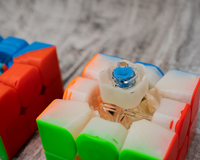
MagLev speedcubes represent the next evolution of traditional (spring) speedcubes, bringing a very significant technology advancement to the cubing world. They replace the spring-loaded mechanisms in the core of traditional cubes with a system of organized repelling magnets inside the core.
So, the stability of the puzzle is now achieved without a spring that pushes the pieces apart, meaning that there is no more physical contact in achieving the same force, and thus, reducing the friction between the pieces! This technology works wonders for every kind of puzzle, and offers smoother turning and even a faster response to individual turns, making the hardware very reliable and longer-lasting.
What is a Traditional (Spring) Speedcube?

Spring-based speedcubes work on a classical spring-screw system, which creates physical tension between the pieces based on the tightness of the screw. So, as the screws on each face are tightened further, the respective springs are compressed further, meaning that they offer a larger resistive force to that face, increasing the tension of the cube.
This design has been used in cubes for ages before the advent of the Maglev cubes. This allows for manually tensioning your puzzle and offers more predictability with regards to the mechanical feel of the puzzles. There are still some cubers that may prefer this setup, but as a speedcuber gets faster, they tend to prefer magnetic cores.
Maglev vs Spring Speedcubes: Key Differences Explained
| Feature | MegLev Cubes | Spring |
| Speed | Very fast | Moderate |
| Stability | High | Moderate-High
|
| Feel | Light & Airy | Firm & rigid |
| Noise | Minimal | Slight spring noise |
| Maintenance | Low (less Wear) | High (springs can wear out) |
| Predictability | Moderate | High |

Who Should Choose MagLev vs Spring?
- Beginner: Spring (better control)
- Intermediate: Either (based on preference)
- Advanced: Maglev (better speed + efficiency)
How did MagLev Technology Evolve?
Cubing technology had come a long way in terms of physical improvements, with a lot of design changes being incorporated. Initially, Rubik’s cubes had flat pieces, which meant a lot of shear force and sliding when making turns.
Over time, ridges were introduced on the inside faces of edge and corner pieces, to allow them to slide with lesser surface area, reducing the friction on each turn.

Additionally, we had completely square corners in cubes, but speedcubes required better corner-cutting, which meant that layers should be able to move in perpendicular directions before the turn is complete, aiding quicker turning.
This led to the creation of squared-off corners, meaning that cuts were made towards the center pieces on each of the corners (creating a diamond shape in the center of the cube).
Physically speaking, the only place left to reduce friction was the internal mechanism of the cube itself. This meant making more than just aesthetic changes to the puzzle, in order to change the very ‘core’ of its movement (pun intended).
An initial move in this direction was to introduce spring tensioning, which was a success and allowed for a little more flexibility, but this simply wasn’t good enough to match the speed requirements posed by modern speedcubing.
This is how the Maglev technology was introduced, to generate the same tension between pieces without maintaining the same contact between them. Magnets within cores slowly got introduced and have since become the norm of professional speedcubing.
They require less effort per move and offer a much more smooth and stable feel, which is why most flagship cubes from brands like GAN, MoYu and QiYi offer Maglev variations that often go on to become their bestsellers.
Summary of Maglev & Spring Speedcubes
|
MagLev Speedcubes |
Spring Speedcubes |
|
Faster turning (good for high TPS solvers) |
Slightly slower (higher friction) |
|
Smoother feel (no spring friction) |
More forgiving to poor turning |
|
Lower maintenance (minimal wear) |
Spring noise (more wear) |
|
Modern experience (flagship standard) |
Less premium feel |
|
Can be too fast at times |
Decent control (natural resistance) |
|
Less physical feedback from the puzzle |
More adjustable feel |
|
Higher prices |
Budget-friendly |
Best Maglev Cubes in India (2026)
While there are plenty of options on the market, some of the best include:
FAQs
Final Thoughts
MagLev and springs speedcubes aren’t about picking between what’s right and wrong; it’s more about the feel of the puzzle and how you adapt to getting faster at turning.
Maglev cubes give you speed and smoothness, while spring cubes can give you control and smoothness. However, the best decision is to try one for yourself now!
The moment that you find which one clicks for you, you might even see a huge jump in your solving level - and that could mean all the difference. Most cubers who switch to Maglev initially feel it’s too fast—but after a few solves, it starts feeling natural.
-- Akshaansh Chilakapati