What is Speedcubing? The Complete Beginner’s Guide (2026)
Speedcubing is the art of solving twisty puzzles (such as the Rubik’s Cube) as quickly as possible. In order to achieve this, speedcubers learn highly efficient solving methods, practice numerous algorithms and optimize their turning technique, all to train themselves to recognize patterns faster.
At the end of the day, that’s all it is—pattern recognition. And despite the name, speedcubing isn’t restricted to people who can solve the cube in just a few seconds. If you have just learned how to solve a Rubik’s Cube and are looking to get faster, you’re already on the path to becoming a speedcuber!
In this guide, we’ll look at how it works, the techniques used by speedcubers, what cube you should buy and what improvement looks like.
What are the Various Twisty Puzzles?
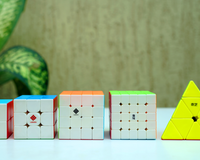
While the classic 3x3 Rubik’s Cube is the most recognizable and famous speedcubing puzzle, it’s far from the only one. There are other puzzles such as:
1) 2x2, 4x4, 5x5, 6x6 and 7x7 (the NxN puzzles)
2) Pyraminx
3) Megaminx
4) Skewb
5) Square-1
6) Clock

Within these, there are various methods to solve each puzzle as well as different variants of puzzles (like 3x3 One-Handed or Blindfolded, for example). These are included in the list of official events recognized and governed by the World Cube Association (WCA), but you don’t need to know these or even compete in order to be a speedcuber!

How Does Speedcubing Work?
A beginner usually solves the cube one piece and one layer at a time, but speedcubing takes this idea and turns it into a more efficient manifestation of the same. Instead of thinking about each move individually, speedcubers recognize familiar patterns and solve them using the registered sequence of moves for those cases, most often recalled via muscle memory.
For 3x3, the most widely used speedsolving method is CFOP, which is Cross → F2L → OLL → PLL. This involves solving the edges of one face to make a cross, and then solving the first 2 layers simultaneously by pairing the corners and edge pieces and inserting them together. Then, we orient the pieces of the top layer, followed by permuting them into their correct positions.
While there are other methods such as Roux and ZZ, this is the most commonly followed one. For other types of puzzles, there are methods that are also extensions of similar concepts and do not take that long to learn! Remember, speedcubing is not just about turning the cube as fast as you can; it also involves improving efficiency, pattern recognition, lookahead, finger tricks and consistency.
Is Speedcubing Difficult to Learn?
It may surprise you, but speedcubing is actually much easier than it looks (and way more fun to learn than most other things).
More often than not, improvement in speedcubing is done in stages, and you rarely need to learn dozens of algorithms at a single time.
Through gradual improvement, you’ll slowly expose yourself to new sets of algorithms that start to reduce the total number of steps required, maximizing efficiency.
This means that, as you improve, you will slowly make a progression into knowing more algorithms and committing them to muscle memory over time.
This prevents you from feeling overwhelmed and trying to learn everything at once. Speedcubing is a skill, like playing an instrument or learning a sport, and improvement comes through a lot of deliberate practice and repetition.
What is an Algorithm in Speedcubing?
An algorithm is basically a predefined sequence of moves that’s used to affect a particular set of pieces on the cube in a predictable way. By learning algorithms, you slowly expose yourself to more patterns that can be solved more efficiently, to the point where you can recognize so many patterns through muscle memory at will.
In general, we follow a fixed notation in cubing, based on the puzzle. For the Rubik’s Cube, we have:
R - Turn the right face clockwise 90 degrees
L - Turn the left face clockwise 90 degrees
U - Turn the upper face clockwise 90 degrees
D - Turn the bottom face clockwise 90 degrees
F - Turn the front face clockwise 90 degrees
B - Turn the back face clockwise 90 degrees
If you see an apostrophe after the letter, then it refers to a counterclockwise turn, while a ‘2’ means the face is turned twice.
You will encounter many algorithms in your speedcubing journey, and a good example is the ‘T’ Permutation, 1 of the 21 existing PLL algorithms, which swaps 2 corners and 2 edges in a ‘T’ pattern. The algorithm for that is (try it for yourself!):
(R U R’ U’) (R’ F R2) (U’ R’ U’) (R U R’ F’)
At first, it may feel like these are things to consciously remember, but with enough repetition, your hands begin remembering the movements themselves, which is known as muscle memory and will help you progress in speedcubing at a much faster pace!
What Skills Make You Faster at Speedcubing?
While raw turning speed is an important part of getting better, one of the more important skills is lookahead, which is the ability to identify what you need to solve next while still being on the current step. This can be developed with more practice and by creating the patterns in your head that make everything second nature to you.
This pattern recognition becomes the foundation of future improvement as well, and experienced cubers can recognize cases almost instantly and go straight into algorithms in a rapid sequence of seamless transitions.
Over time, you will also develop good finger tricks and have to unlearn bad ones, which will allow you to turn efficiently without constantly changing your grip on the cube.
Lastly, good speedcubers do their best to reduce unnecessary moves and pauses, because a smooth solve at a slightly slower turning speed can often be faster than a frantic solve filled with stops and regrips.
What Cube Should a Beginner Buy?
As a beginner, you do not need an expensive flagship puzzle to start your speedcubing journey. However, it is recommended to use a modern speedcube instead of an old stiff puzzle, because this enables you to get faster quicker and will also make the learning process more fun overall.
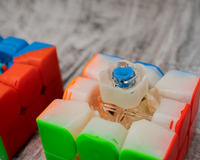
Ideally, you want to get a cube with magnetic positioning, good corner cutting, adjustable tensions, and a stable, controllable feel.
Magnetic cubes are useful, as they help the layers align as you turn and can offer additional stability.
There are excellent beginner speedcubes available at relatively low prices, such as the MoYu RS3M v5, or the GAN 356 ME. As you get better, you will develop preferences for things such as magnetic strengths, tensioning, lubrication viscosity, etc.
Do You Need a Timer for Speedcubing?
Not immediately, because many digital timers, such as csTimer or CubeDesk for PC and Twisty Timer or Chao Timer for mobile phones, are available to use for free. These timing software will allow you to record your solves, calculate averages, generate scrambles, and track your overall progress.
Eventually, you can consider getting a dedicated speedcubing timer that will function exactly like it would in an official competition. This will enable things like competition simulations and maybe even help you get used to the feeling of competing from your desk at home.
Can You Compete in Speedcubing?
Absolutely! You do not need to be fast at cubing to go to a competition. Most competitions do not have a qualification cutoff for the Rubik’s Cube, and cubers from a wide range of ages and experience levels are equally welcome to participate.
Official speedcubing competitions are overseen around the world by the World Cube Association (WCA). At these competitions, in a standard speedsolving attempt, the puzzle is scrambled using an official computer-generated scramble, and competitors get up to 15 seconds to inspect the puzzle before beginning their solve. Competitors typically complete 5 solves in a full round, with the result being calculated as a cubing average of five, wherein the best and worst times are removed, and the arithmetic mean of the others determines your average.
Remember, you do not have to wait until you’re ‘fast enough’ to attend your first competition. If you can solve the puzzle within the competition’s applicable time limits and understand the basic rules, it’s absolutely worth going to a competition and integrating yourself with the beautiful community of speedcubing!
Is Speedcubing Good for Beginners?
Yes. One of the best things about speedcubing, especially early on, is that progress is very easy to see.
Your first few solves might take minutes, but breaking the 1-minute barrier might only take you a week at the most!
Eventually, you’ll be chasing sub-30, sub-20 and so on, with the barriers getting tougher to break but more and more rewarding.
In speedcubing, your biggest opponent is mostly yourself, and your goal is to compete against your own previous times, which is a greater motivation than anything else.
Conclusion
Speedcubing takes the challenge of simply solving a Rubik’s Cube and turns it into a sport and a skill that you can continuously refine over time.
You don’t need thousands of algorithms or an expensive cube to begin. Start by just learning how to solve the cube consistently and slowly work on reducing your pauses, learning more efficient techniques and gradually adding new algorithms.
Most importantly, don’t compare your journey and your first few weeks of cubing with someone else’s years of practice.
Every fast speedcuber you know was once exactly where you were. Solve, practice, improve and repeat, and you’ll find yourself beating your personal records and getting better in no time!
That’s the art of speedcubing.