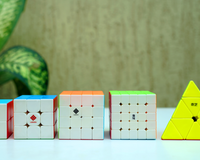




The Basic Idea Behind Solving Big Cubes
If you already know how to solve a 3x3, and a 4x4, you can easily learn how to solve a 6x6 and 7x7 without any extra algorithms! The same reduction approach as the 4x4 is used for big cubes as well, it’s just going to take longer to solve because of the sheer amount of pieces in 6x6s and 7x7s. It is recommended to learn the 5x5 as well before attempting the 6x6 and 7x7, but it is possible to skip straight to the 6x6 after the 4x4!
Let’s go over it step by step. First, you solve the centers, then you pair up all the edges, and then solve the cube like a normal 3×3. The only extra hard part is understanding how to deal with parity instances, which might be tricky on the 6×6. But you might already have handled parity in the 4x4, the algorithms used are the same!
See? Big cubes may seem scary, but as you break them down into easy steps, they start making sense and are surprisingly fun to solve.
Quick Comparison: 6×6 vs 7×7
| Feature | 6x6 | 7x7 |
| Fixed center | NO | YES |
| Center size | 4x4 | 5x5 |
| Edge pieces per edge | 4 | 5 |
| OLL parity | YES | NO |
| Edge / PLL parity | YES | YES |
Understanding the Difference Between 6×6 and 7×7
The biggest difference between these two cubes is how the centers behave.

- 6×6 cubes don’t have fixed center pieces, so you have to remember the correct colour scheme of a regular 3x3 while solving. You should have this memorised by now!
- 7×7 cubes have a fixed center, which makes it much easier not to mess them up.
Even experienced cubers who have the color scheme memorized by heart mess up the 6x6 centers sometimes, so in that aspect, the 7x7 is much easier to solve because you don’t have to care about the color scheme, as you have a fixed center telling you which color goes where!
During the edges and the 3x3 stage, both cubes can have edge parity, but only the 6×6 has OLL and PLL parity.
Step 1: Solving the Centers
Every big cube solve starts with solving the centers.
General approach
- Solve one full center
- Then solve the opposite center
- Move on to the remaining centers one by one
On the 6×6
- No fixed center, so remembering the colour scheme is important
- You can use the corner pieces as reference if you don’t have the color scheme memorized
- The key is to build 1×4 bars, then merge four of them into a 4×4 center
On the 7×7
- You have a fixed center that acts as a guide
- The key is to build 1×5 bars, then combine them into a full 5x5 center
- Alignment is way more easier than on the 6×6
Important tip: You might know how to preserve a center while solving another from a 4x4. Same thing here! Always undo slice moves carefully so you don’t disturb completed centers.
Step 2: Pairing the Edges
Once the centers are done, the next step is edge pairing.

- A 6×6 edge has 4 matching pieces to pair
- A 7×7 edge has 5 matching pieces to pair
Edge pairing method
- Combine matching edge pieces together using inner slices
- Pair them into one complete edge
- Store solved edges in the top and bottom layer
- Replace them with unsolved edges
This step is exactly the same as the 4x4 beginner method and is mostly intuitive once you get used to the movement of inner layers.
Common Parity Algorithms

We have finally arrived at the dreaded parity algorithms! Thankfully, they’re the same as the 4x4 so you can reuse the 4x4 algorithms safely but instead of 2 layers, you’d turn 3 layers. We’ll also be writing out the algorithm so you can understand it!
OLL Parity (6×6 Only)
An OLL parity looks like a weird case that you’d never encounter on a 3x3. It occurs as one singular flipped yellow edge while the other three are correctly aligned. You might have seen it on a 4x4, it looks exactly the same, but bigger!
OLL parity happens only on even-layered cubes like the 4x4 and 6×6. Algorithm to fix it
3Rw, U2, X, 3Rw, U2, 3Rw, U2, 3Rw', U2, 3Lw, U2, 3Rw', U2, 3Rw, U2, 3Rw', U2, 3Rw'
This is the exact same algorithm as the 4x4 parity but the only difference is the number of layers turned!
Edge Parity (6×6 and 7×7)
Edge parity can be seen on both 6x6 and 7x7 and is encountered while solving edges. Two of the identical side edge pieces are interchanged. This can be solved using the exact same parity algorithm above, but you have to be careful to check whether to turn 3 layers at once or only 2!
PLL Parity (6x6)
PLL parity is only present on the 6x6, and looks like a PLL case that you’ve never ever seen on a 3x3! That’s the sign of the PLL parity! You just have to do one algorithm with yellow (or your opposite main color) on top.
Algorithm to solve it:
3Uw2, 3Rw2, U2, 3Rw2, R2, U2, 3Rw2, 3Uw2
Step 3: Solve It Like a 3×3

After centers and edges are solved, you can move on to solving the 6x6 and 7x7 just like a regular 3x3! You can use your 3x3 method, it could be CFOP, Roux, Beginners, anything. Just be wary of parity on the 6x6. The 7x7 feels much smoother during this stage because there’s no parity.

Recommended Cubes & Accessories
6×6 Cubes
7x7 Cubes
Useful Accessories
FAQs
Happy cubing!